
Appearance
Account Type
An account type is a category of patient account — Cash, Medicare, Medicaid, PPO, HMO, Workers' Comp, Personal Injury, Auto — and it carries the financial defaults that go with it.
Every patient has one, and it is what makes a Medicaid patient behave differently from a cash patient without anybody having to remember to set it.
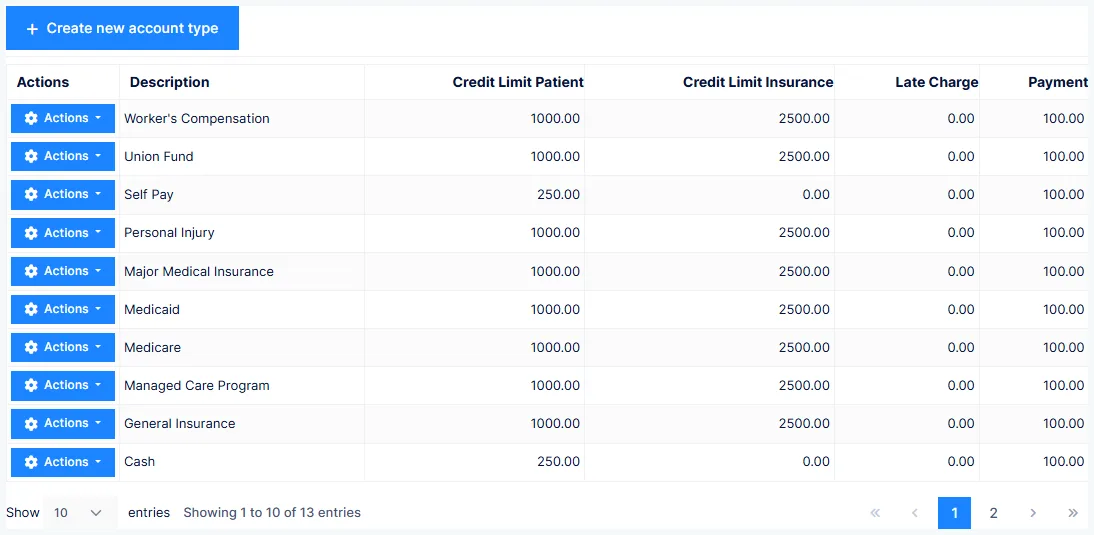
The grid lists ID, Description, Credit Limit Patient, Credit Limit Insurance, Late Charge and Payment.
Identification
| Field | Notes |
|---|---|
| ID | Up to 5 characters, permanent once saved. Use at least 2, preferably 3 — single characters cause confusion later. Typical: CASH, MC, MD, HMO, PPO, WC, PI, AUTO |
| Status | Active or Inactive |
| Description | The full name, up to 40 characters |
Keep account types broad
Resist the urge to sub-categorise here. If you need finer distinctions — this HMO versus that one — the Carrier catalog is where those belong. A short, coarse account type list stays usable; a long one doesn't.
The defaults it carries
Selecting an account type on a patient fills in these values automatically. Each can then be changed on that individual patient.
| Default | What it sets |
|---|---|
| Patient Credit Limit | Balance at which staff get a warning |
| Insurance Credit Limit | Same, for the insurance balance |
| Receipt | Yes / Payment / No |
| Statement | Always / Never / Amount Due |
| Payment Agreement | Minimum monthly payment, as a percentage or a dollar amount |
| Late Notice | Gentle / Normal / Persistent / None |
| Late Charge | Percentage, dollar amount, or none |
Credit limits warn, they don't block
Exceeding a credit limit alerts your front desk. It does not stop new charges being entered. It's a prompt to have a conversation, not a gate.
Receipt
No is the usual choice — receipts still print on demand, and nothing is wasted. Payment suits cash and self-pay patients. Yes prints one every single visit, which most practices find is a lot of paper nobody wanted.
Payment Agreement
Defaults to 100%.
Leave it at 100% here
Change it on the individual patients who genuinely need a payment plan, rather than lowering the default for a whole category and quietly under-billing everyone in it.
Medicaid needs specific settings
Billing a Medicaid patient is unlawful
For Medicaid account types set Statement to Never and Late Notice to None.
Those two settings are what stop a statement or a collection letter going out to a patient you are not permitted to bill. They are legal protection, not a preference.
Late charges
You must be able to prove the patient was told
Federal regulations require patients to be notified in advance that late fees or penalties may be charged — and require you to have proof they were told. A signed statement in the patient's intake paperwork is the usual form.
No proof, no late fee.
Late notice wording lives in the collection plan templates. Review and adjust those before assigning a late notice level here — otherwise you are choosing between tones you haven't read.
Specific associations
Optionally tie an account type to one Attorney, one Carrier, or one Employer, each picked from its catalog. Those catalogs must be populated first.
Only when there's exactly one
These are for cases where one specific entity always applies — a workers' comp account type that is always the same carrier, say. If more than one could apply, leave the field blank rather than picking a representative one.