
Appearance
Family
Family structure and the conditions that run in it. Three tabs: General, Illness and Family Members.
General
| Field | Records |
|---|---|
| Marital status | Single, married, divorced, widow or widower |
| Spouse's occupation | |
| Patient has children | With how many boys and girls |
| Is the patient's caregiver responsible for the care of anyone else? | |
| Patient's parents are alive — and father / mother individually |
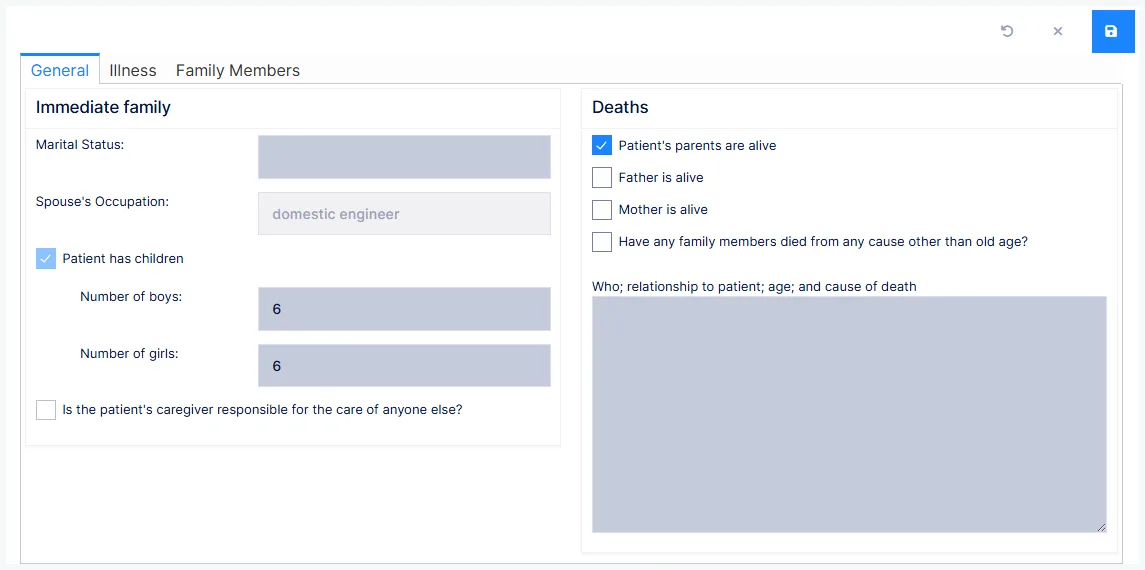
Deaths
Have any family members died from any cause other than old age? — and if so, who, their relationship to the patient, their age, and the cause of death.
Cause of death is family history, not trivia
Where a parent died young of something heritable, that is exactly the context a later diagnosis gets read against. It is a short question at intake and awkward to raise later.
Illness
Does any member of the family have any of the following illnesses? — a checklist of around fifty conditions, from the hereditary ones that matter most (cancer, diabetes, hypertension, rheumatoid arthritis, osteoarthritis, hypothyroid, gout, asthma) through infectious diseases (hepatitis A/B/C, tuberculosis, meningitis) to the childhood illnesses.
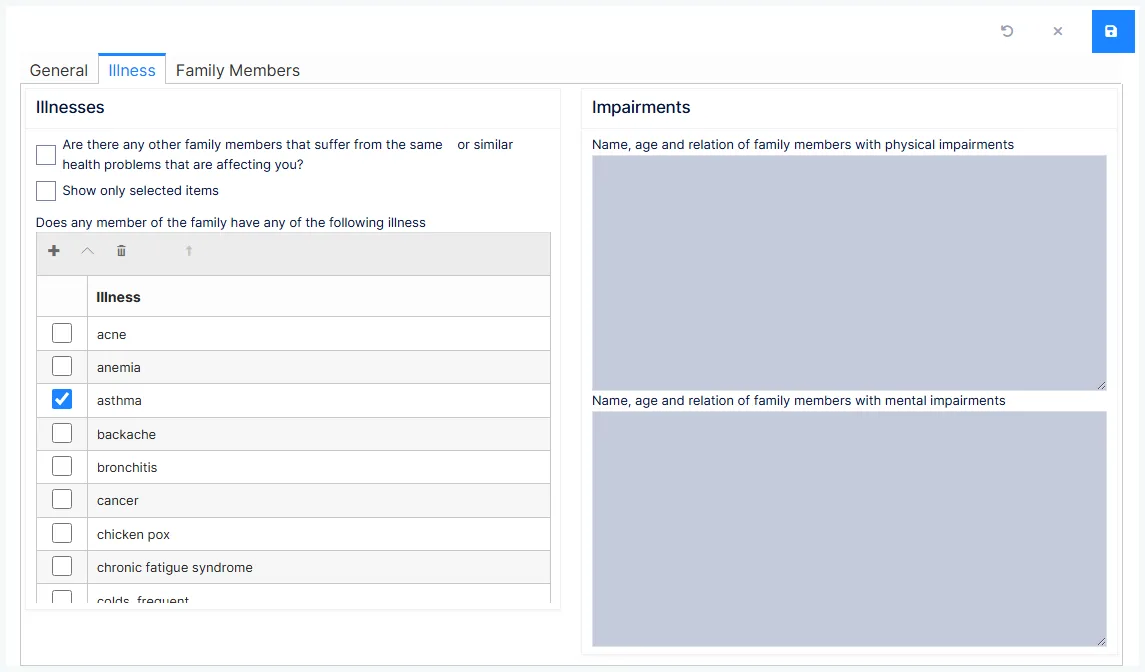
Tick Show only selected items to collapse the list to what you've marked.
Below it, two free-text fields for the name, age and relation of family members with physical impairments and with mental impairments.
Family Members
Specific relatives — each with a relation and a name — and the problems associated with each, marked please check all that apply.
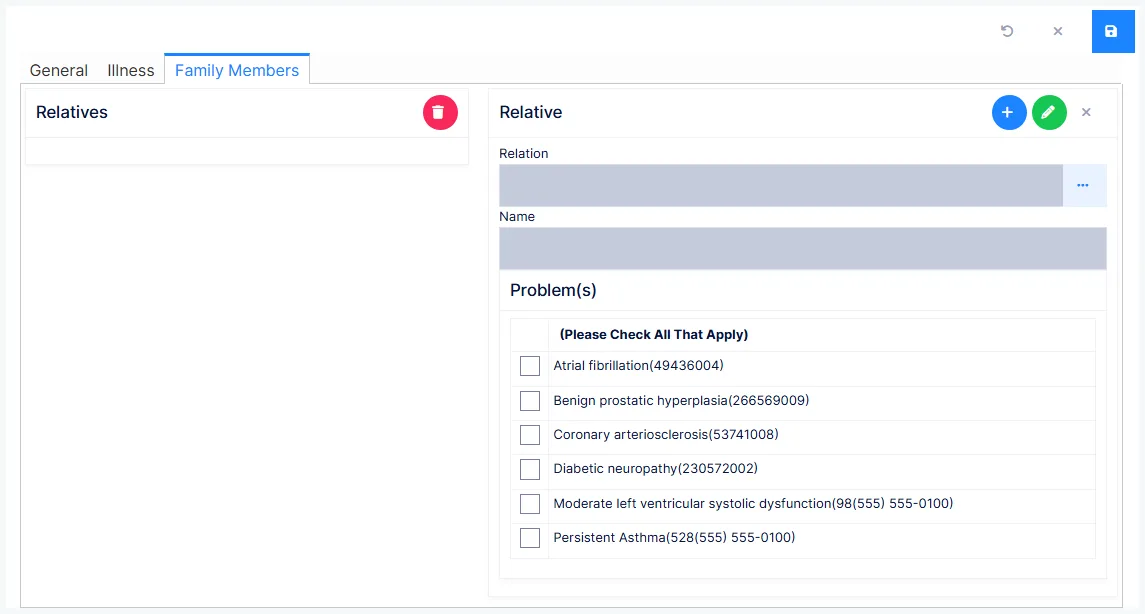
The problems here are coded, not typed
The problem list uses SNOMED clinical terms, each shown with its concept code — for example Atrial fibrillation (49436004) or Coronary arteriosclerosis (53741008). A family history of a condition is therefore recorded as the same concept every time, so it can be reported on, exchanged with other systems, and counted for quality measures.
Pick the closest matching term; that matters more here than the wording would in a note.