
Appearance
Document
The Documents screen holds what has been produced for the patient — SOAP notes, narrative reports, and letters. It has four tabs: New, Prior, Narratives and Letters.
What is actually stored — and what isn't
This is the most important thing to know about this screen, because the tabs behave differently:
| Tab | Kept? |
|---|---|
| Prior (SOAP notes) | Full text stored permanently |
| Narratives | Full text stored; reopen, reprint or export any time |
| Letters | Only a record that it was produced — no copy of the document |
A letter's content is not retained
The Letters tab logs the date and the name of what was printed, not the document itself. If you need to be able to reproduce exactly what a patient or attorney was sent, do one of:
- build it as a Narrative template instead, which is stored, or
- print it and scan it into the patient's Scanned Documents
Letters also print immediately to the default printer when selected — there is no preview or edit step.
The Letters tab doubles as a produced-correspondence log: patient statements, late notices and bulk-produced letters all appear there too.
Prior notes
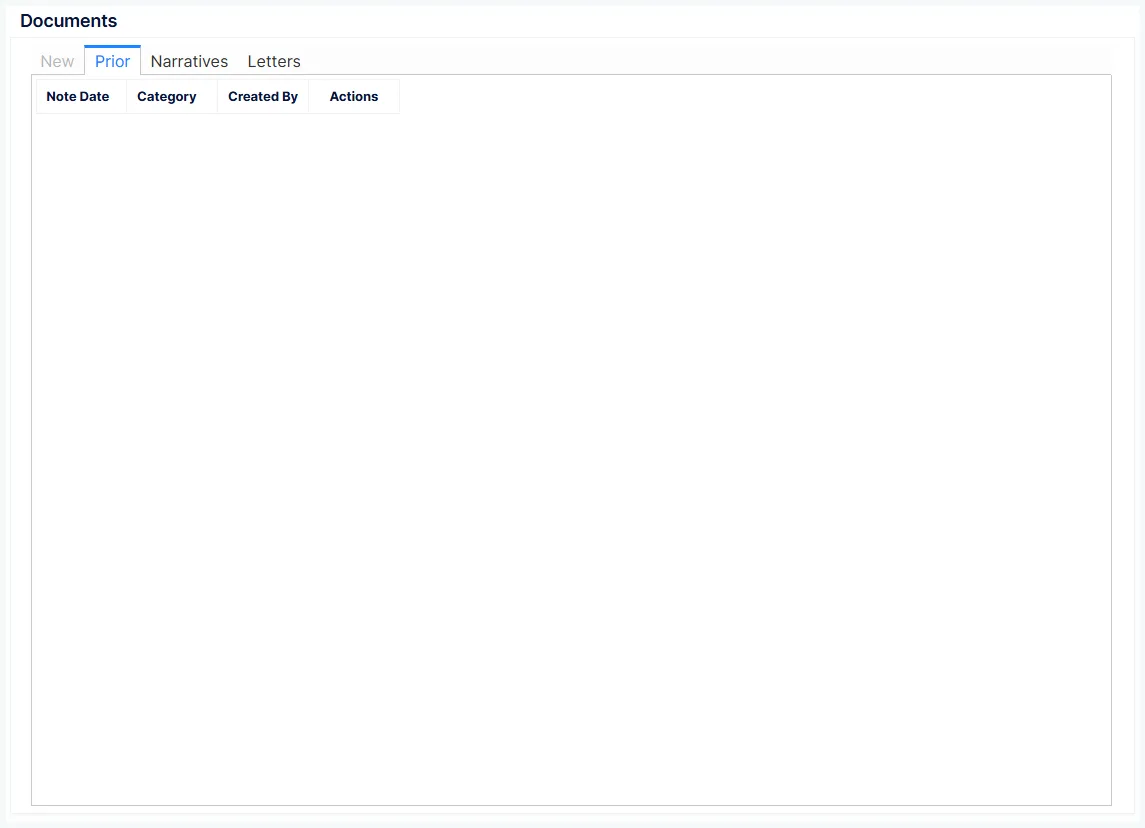
SOAP notes, newest first, with the Category assigned when the note was generated and the staff member who created it.
Categorise at generation time
The Category is what makes a specific note findable months later. It costs nothing at generation and cannot be added retrospectively without editing the note.
Editing a note after the fact
The 72-hour rule
Medicare requires a SOAP note to be completed within 72 hours of the visit. Any change made after that window must be entered as an Addendum — not as an edit.
ChiroPad records the date and time of every entry in a HIPAA/HITECH audit log, and auditors know where to find it. A note edited outside the window without an addendum is what turns a paperwork lapse into an accusation of fraud.
Even inside 72 hours, an addendum is the safer habit.
An addendum captures its own date, the original report's date, and the logged-in user automatically. You must supply:
- the name of the doctor making the addendum
- the addendum text
- the reason it is being made
That three-part format is required at both state and federal level.
Some reports — muscle tests among them — cannot be edited after saving at all. An addendum is the only route, deliberately, so the record cannot be quietly altered.
Narratives
Narrative reports are generated from templates, then editable in place. Reopen one by clicking its date. Save explicitly when you are done.

Export produces an RTF file for emailing.
Send PDF, not RTF, to anyone outside the practice
An RTF can be edited by anyone with a word processor. A PDF is substantially harder to alter — which matters when the recipient is an attorney or a carrier.
Letters
Click New Letter and choose from the list. It prints straight away.

The available letters and narrative templates are authored in the SmartPad Template Editor — anything saved there appears in these lists automatically.
Electronic signature
The Initials field determines the electronic signature at the end of a generated note, drawn from the provider's record.
Initials alone are no longer sufficient
Medicare and state boards now require the provider's full name and credentials on each note. Set the provider's Initials field to the full name with credentials, and enable the extended signature format so each note ends with "Electronically Signed By [name and credentials] [date] [time]".
Choosing what goes into a note
Each section of the note can be forced in or suppressed out.
Suppress All produces a non-compliant note
It generates a note that no longer meets the minimum Medicare requires, or the rules of many state boards. Force All goes the other way and pads the note with material that was not recorded on that visit.
Medicare's current minimum is patient comments and complaint history, the physical findings for that visit, the condition status, the current active diagnosis, and the treatment plan.
Visitometers
Two counters sit alongside the note, each showing whether it has expired and how many visits remain:
- DX Visitometer — tied to the current diagnosis set
- Plan Visitometer — tied to the current treatment plan
The DX Visitometer is a re-examination reminder
Medicare requires a re-evaluation at least every 30 days while a patient is under active treatment. Watching the diagnosis counter is a practical way to catch that before it lapses.