
Appearance
Treatment Plan
What you intend to do, how often, and for how long. It is the most consequential screen in the clinical record: it drives the charges on the transaction, the expected services on the next appointment, and several things carriers specifically look for.
The plan carries forward
Each visit opens showing the previous visit's plan. If nothing has changed, you need enter nothing — the note uses the existing plan. If something has changed, change only that.
Silence means "same as last time"
This is deliberate: the routine visit costs nothing to document, and a change is a small edit rather than a re-entry. Clicking New starts a fresh plan and clears the visit status, plan phase, provider and visitometer.
The header
| Field | What it sets |
|---|---|
| Visit Status | How often the patient should be seen |
| Plan Phase | The phase of care |
| Provider | Who is delivering it |
| Visitometer | When the plan expires — by date, by visits, or both |
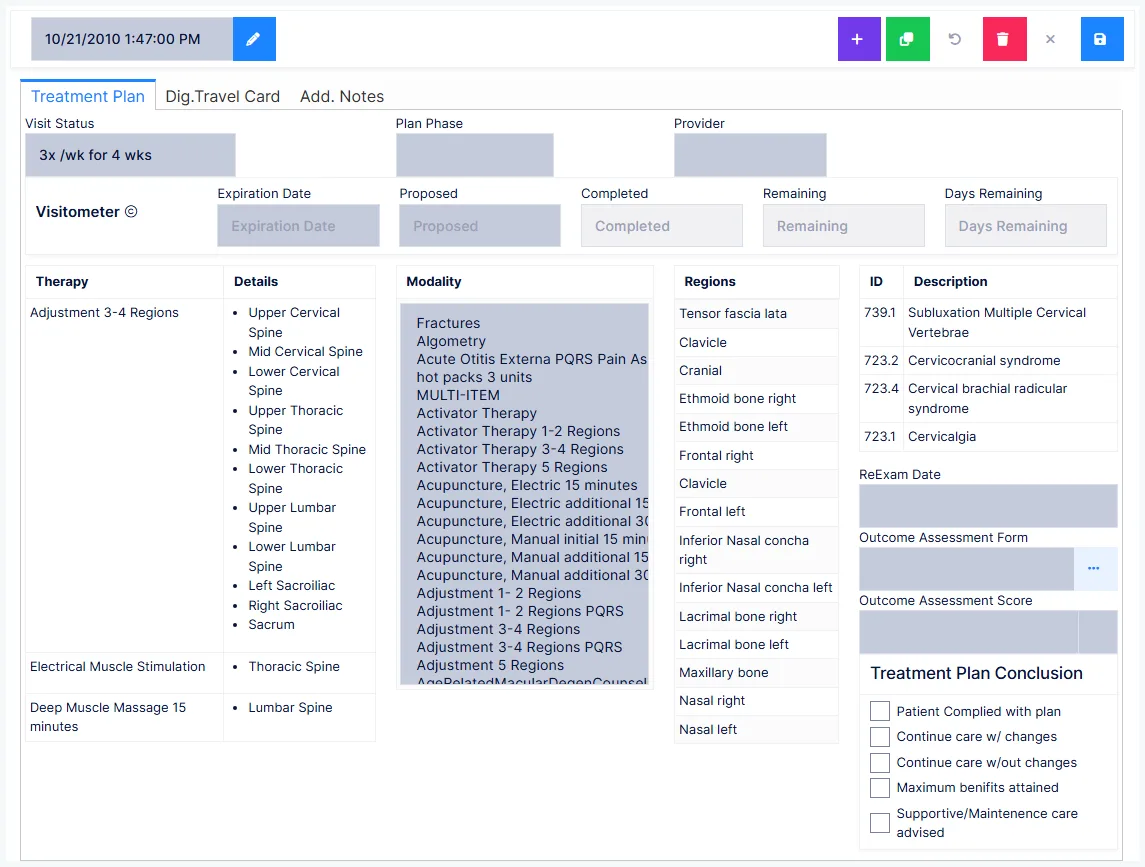
Visit Status
The recommended frequency: 3x/wk for 4 wks, 2x/wk until next exam, 1x/wk for 3 wks, Return as needed, Daily, and so on.
Required documentation
Recording when or how often the patient will be treated is required by all state boards, the federal government, and many insurance programs.
It is also what the front desk uses at check-out — the visit status appears on the appointment screen so staff book the right pattern. 3x/wk for 4 wks means twelve appointments.
Plan Phase
Acute, Chronic, Palliative, Restorative, Rehabilitative, Supportive, Maintenance, Preventative, Active, Passive, Therapeutic, and staged variants.
This is the highest-consequence field on the screen
Plan Phase is a Medicare requirement, a legal requirement in some states, and an insurance mandate in the rest. Some states dictate the exact phase names you must use — check what applies where you practise.
If it is missing, a carrier reviewing the notes can reject all claims and demand refunds of payments already made.
ChiroPad allows it to be left blank. Don't.
Visitometer
Sets when the plan runs out — an expiry date, a proposed number of visits, or both. After saving, ChiroPad tracks completed, remaining and days remaining, and shows them on the note screen too.
Two different counters
The plan visitometer covers the whole course of care. The diagnosis visitometer, set on the Diagnosis screen, tracks the current diagnosis set. They may run to different horizons — the plan one is usually the longer.
What you're doing — modalities and regions
Build the therapy list by choosing a modality and the regions it applies to. A modality only joins the list once at least one region is selected, and deselecting every region removes it again.
Each line can carry:
- a provider, where different people deliver different services on the same visit
- one or more diagnoses, linking the treatment to what it treats
Linking diagnoses to lines is what stops bundling
The same linkage that appears as diagnosis pointing on the claim starts here. A therapy tied to the diagnosis it addresses is assessed under that benefit; everything pointed at everything gets paid at the most restrictive one.
The plan generates the charges
Services documented here produce the corresponding charges on the Transactions screen.
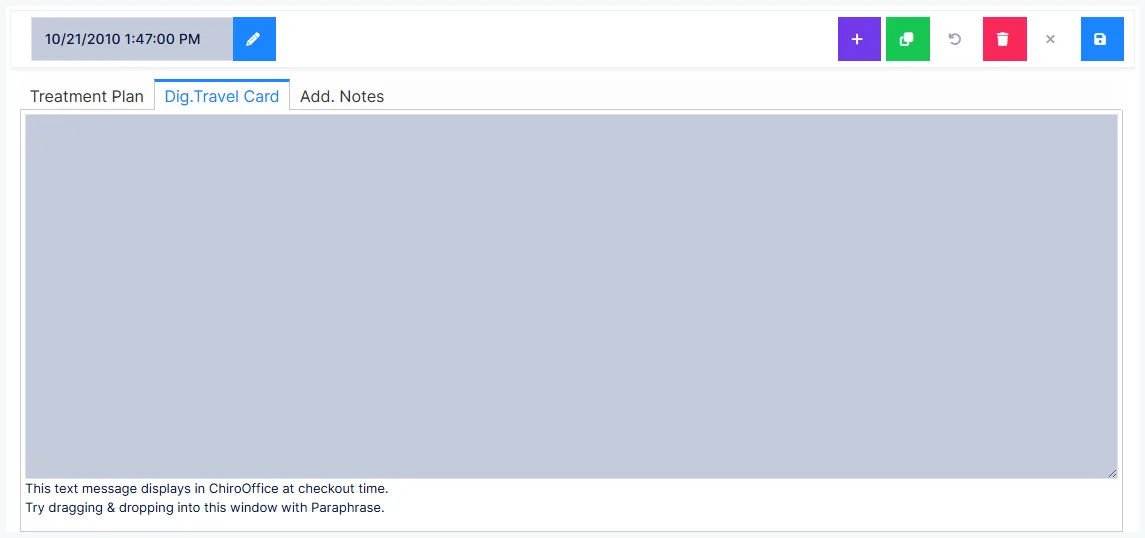
Enter the plan while the patient is still in the room
This is the sequence the whole design rests on. Document the plan before the patient reaches the desk, and the charges are waiting, the visit status tells staff what to book, and the billing matches the record — which is exactly what an audit tests.
Enter it afterwards and the front desk has nothing to work from.
A modality with no linked procedure bills nothing
Each modality has to be mapped to a billable procedure in the Procedure catalog. An unmapped one generates no charge at all, silently.
Re-examination and outcome assessment
| Field | Purpose |
|---|---|
| Re-Exam Date | When the patient is next due to be re-evaluated |
| Outcome Assessment Form | Which instrument was used |
| Outcome Assessment Score | The result, as a number or a percentage |
Available forms include the Oswestry Disability Index, Neck Disability Index, Headache Disability Index, Roland Morris Low Back Questionnaire, Copenhagen Neck Disability Scale, Bournemouth (pre and post treatment), Patient Specific Functional Scale, Pain Disability Questionnaire, Rand Health Survey and the Pittsburgh Sleep Index.
Medicare's 30-day rule
A patient under active treatment must be re-examined at least every 30 days, and the re-examination must include a Functional Outcome Assessment. The expected next examination date has to be recorded on the initial visit and at every re-evaluation.
Medicare also requires proof the patient completed the form themselves — normally their signature. Recording the score here does not by itself satisfy that; keep the completed form.
Conclusions
Five checkboxes describing what happens at the end of the plan:
| Option | Meaning |
|---|---|
| Patient complied with plan | Independent of the others |
| Continue care with changes | |
| Continue care without changes | |
| Maximum benefits attained | Dismissal from active treatment |
| Supportive/maintenance care advised |
The three continue/conclude options are mutually exclusive.
"Maximum benefits attained" is a one-way door
It declares the patient dismissed from active treatment. If it appears in a note, every service billed after that date can be rejected as not therapeutic.
Use it when you mean it, and not as a way of saying the patient is doing well.
Maintenance care is not reimbursed
Advising supportive or maintenance care is a legitimate clinical recommendation, but insurance programs do not pay for it. Recording it sets the expectation correctly for everyone.
Notes and messages
Two text areas that go to different places:
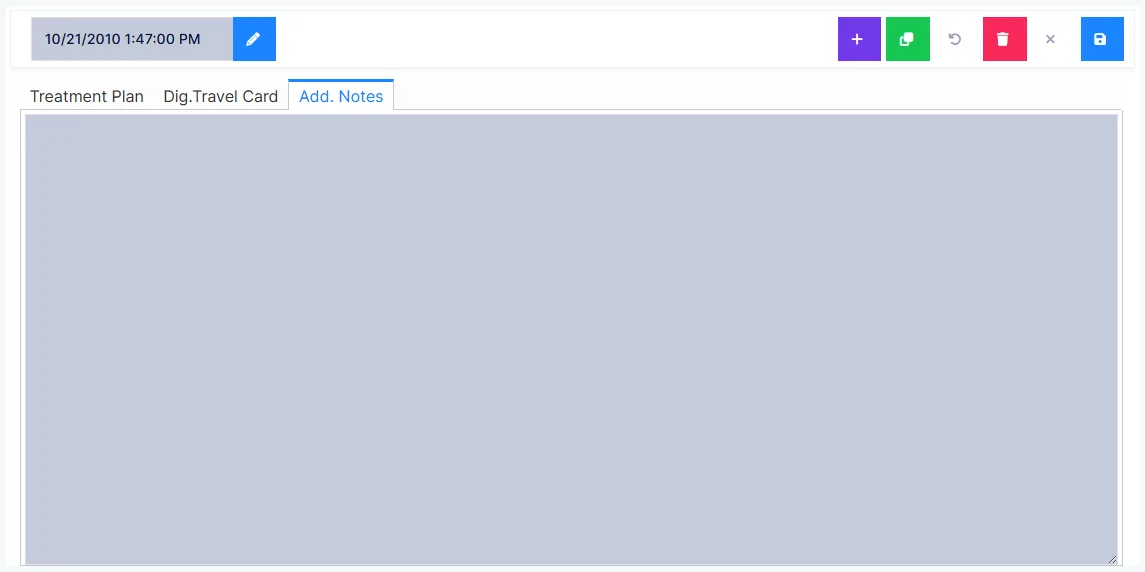
| Field | Goes to |
|---|---|
| Digital Travel Card | The Transactions screen — a message to the check-out desk |
| Additional Notes | The SOAP note itself |
Choose deliberately
A note to your front desk about the patient's payment plan belongs on the travel card. A clinical observation belongs in Additional Notes, where it becomes part of the record.