
Appearance
Physical
The general physical examination — vital signs, posture and gait, and the head, heart and lung systems.
Why it earns its place
A physical examination sometimes turns up something that needs urgent attention. More often it tells you what not to do — the contraindications that shape which modalities are appropriate for this patient.
Six tabs: Vital Signs, Postural/Mental/Physical, Head, Heart, Lungs and Growth Chart.
It opens showing the last examination
The screen loads with the previous examination's entries in place, so on a re-examination you change what has changed rather than re-entering everything. A first examination opens blank.
Vital Signs
| Field | Notes |
|---|---|
| Height and Weight | Drive BMI, the growth charts, and the occupant details in an Auto Accident collision estimate |
| BMI and Weight Status | Calculated automatically |
| Temperature, Pulse, Respiration | If measured |
| Blood Pressure — right and left | |
| Comparison Blood Pressure | Tick to enable post-treatment readings |
| Blood Type |
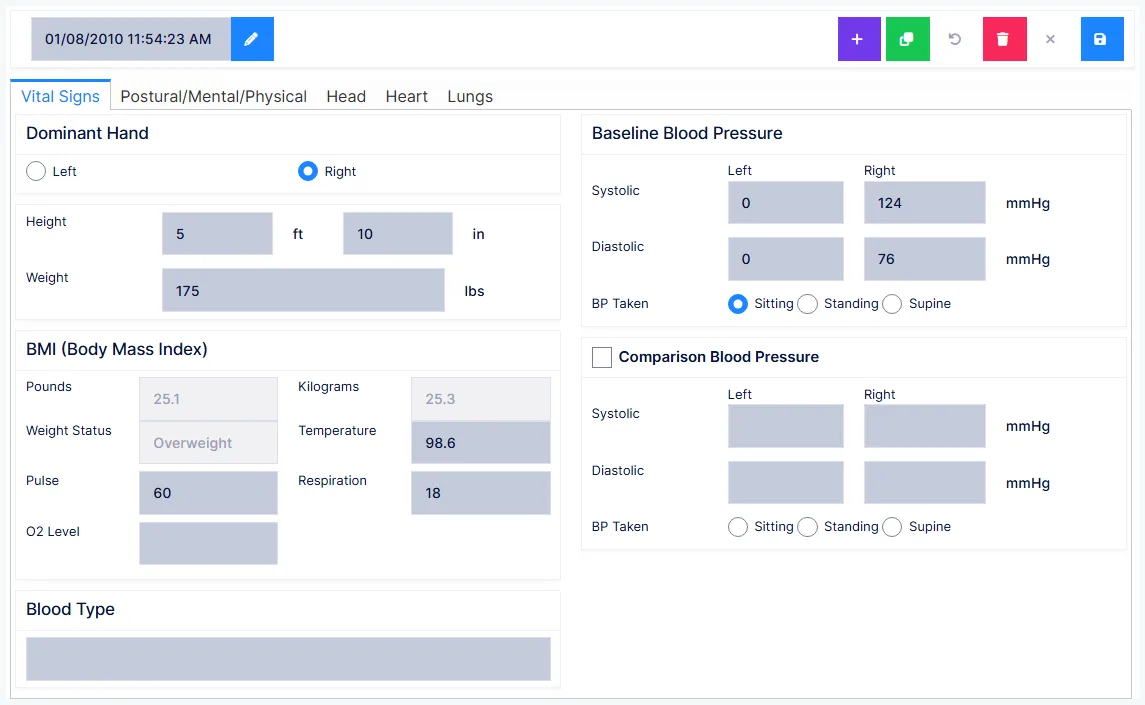
The BMI formula is Medicare's, not a clinical judgement
BMI and weight status use the formula Medicare accepts. It takes no account of build, so a muscular patient can come out as overweight or obese when they plainly are not. Read the number for what it is — a required measure, not an assessment.
Recording pressure before and after treatment
Ticking Comparison Blood Pressure opens a second set of fields so you can capture a reading after the adjustment as well as before it, and show the immediate effect.
It is also worth noting the patient's posture — sitting, standing or supine — since it changes how the reading should be read.
Postural/Mental/Physical
Gait and limp, plus checklists for posture and mental state, and dropdowns for movement (restricted motion), physical build and physical fitness.
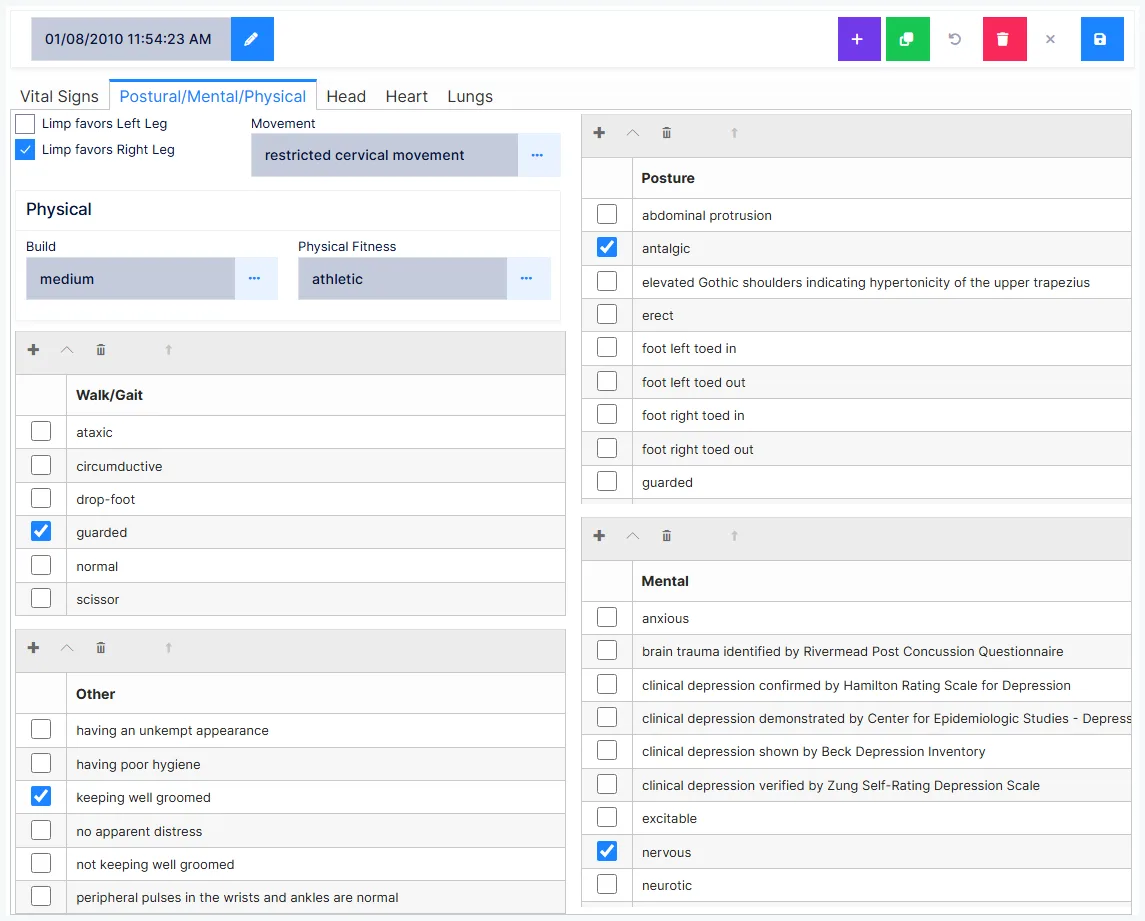
The Mental checklist takes outcome-test results
If you administer a depression, anxiety or similar screening instrument, its result can be recorded here rather than being left in a paper file.
Head, Heart and Lungs
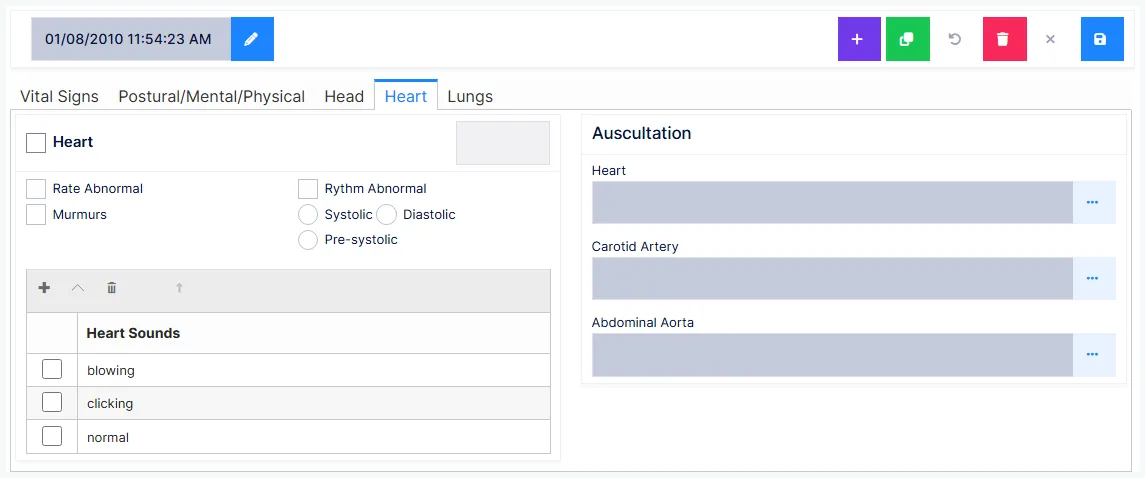
These three tabs work by progressive activation — nothing is live until you say you examined that system.
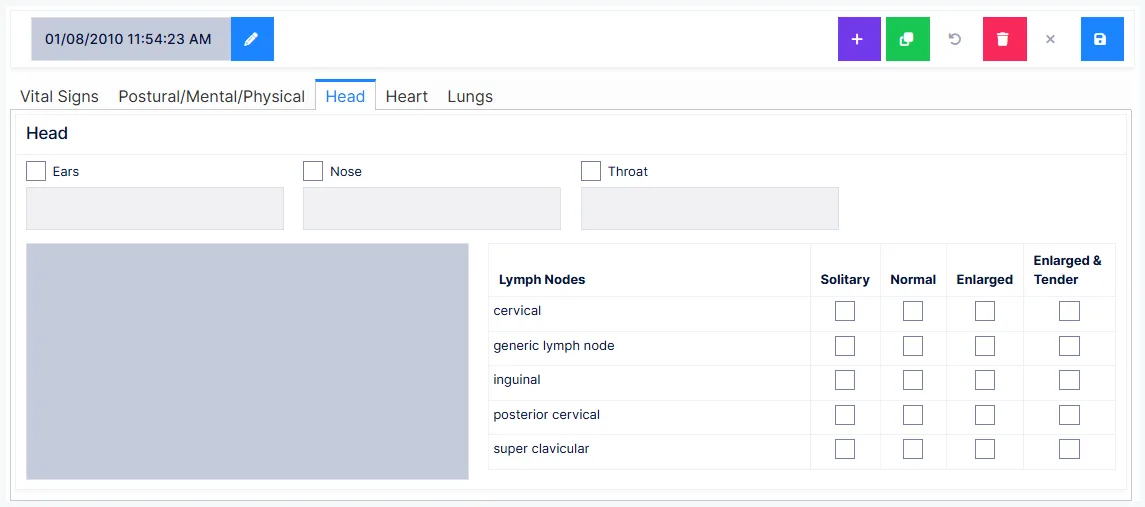
Head — ticking Ears, Nose or Throat enables a normal/abnormal choice for that area, and choosing abnormal is where you describe the finding.
Heart — tick Heart to activate the tab at all. Choosing Normal ends it there. Choosing Abnormal opens up rate, rhythm, murmurs, heart sounds and auscultation. Ticking Murmurs in turn opens the murmur types.
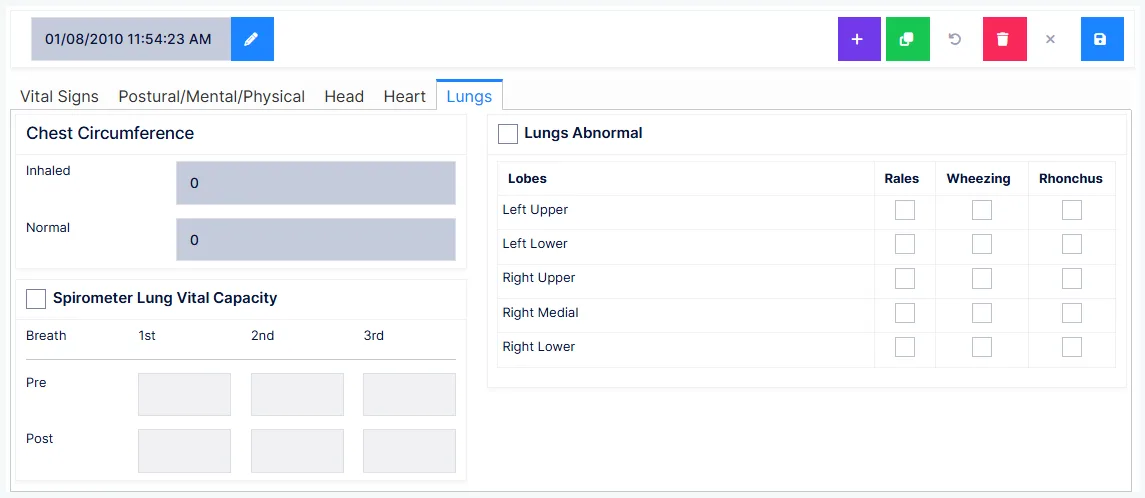
Lungs — record chest circumference twice, at normal breathing and at full inhalation held; the difference is the finding. Lungs Abnormal opens the per-lobe grid for rales, wheezing and rhonchi.
Spirometry is three repetitions, twice
A vital-capacity measurement needs the patient to repeat the test three times to be reliable. Run the set before treatment and again afterwards if you want to show the immediate effect.
Skipping a tab is fine — leaving it half-done is not
Each of these tabs can be skipped entirely if you don't examine that system. What causes problems is a tab that says you examined something and then doesn't say what you found.
Growth Chart
Height and weight charts, shown automatically for patients aged 2 to 20 and hidden outside that range. They are built from the patient's date of birth and the height and weight on the Vital Signs tab — there is nothing to enter, and they are for viewing and printing.
Adding to the checklists
Every checklist ends with a blank row you can type into, which is how the lists grow to fit your practice.
A new entry is added for every patient, permanently
Typing an item into a checklist does not just add it to this patient's record — it becomes a permanent part of that list for every patient from then on.
Two consequences: word it so it reads sensibly on somebody else's chart, and remember that adding an item does not tick it. You still have to check it for this patient.
What Medicare is looking for here
Optional to the software, not to your regulator
Every field on this screen is optional as far as ChiroPad is concerned. Depending on your involvement with Medicare or other programs, and your state's rules, several of them are not optional at all.
Specifically, these are captured here and reported elsewhere:
- BMI and weight status — from height and weight
- Blood pressure screening — one reading, right or left, is enough for the measure
- Growth charts — for patients aged 2 to 20